

Early Warning Systems Strengthening Sri Lanka’s Climate Resilience
 Early warning systems are a critical component of national disaster risk reduction and climate adaptation efforts. In Sri Lanka, where weather-related hazards such as intense rainfall, strong winds, extreme heat, rough seas, and tropical cyclones are becoming frequent, timely and accurate meteorological forecasts play a vital role in protecting lives and supporting sustainable development.
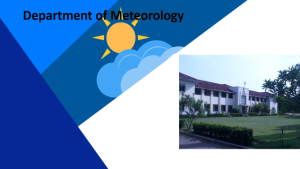
The Department of Meteorology (DoM) functions as Sri Lanka’s national technical authority for weather forecasting, climate monitoring, and the issuance of meteorological advisories and early warnings. Through continuous scientific observation and expert analysis, the Department provides authoritative information that enables risk-informed decision-making across multiple sectors.
Sri Lanka’s early warning systems are built on a comprehensive observation network that includes surface meteorological stations, upper-air monitoring systems, satellite observations, and ocean-related data. Numerical Weather Prediction (NWP) techniques use mathematical models applied to historical and real-time observational data to support weather forecasting and the issuance of warnings.
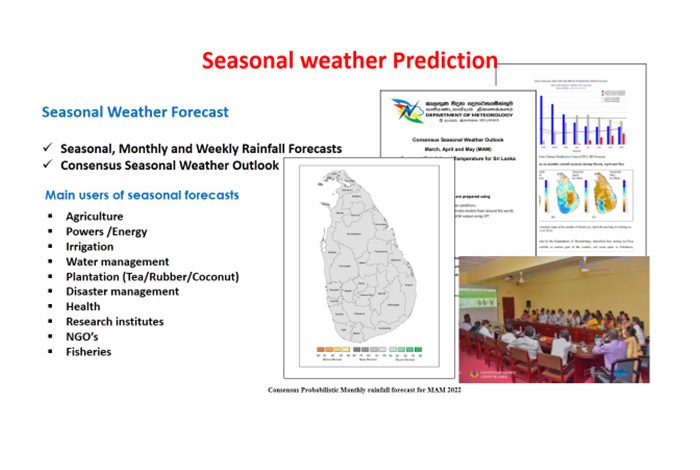
Using real-time data and forecasting models, the Department of Meteorology produces daily, weekly, and seasonal forecasts. It issues forecasts, watches, advisories, and warnings for hazards including heavy rainfall, strong winds, lightning, extreme heat, rough seas, high waves, tropical cyclones, and tsunami-related meteorological conditions. Stakeholder coordination meetings are conducted before and during adverse weather events to strengthen preparedness and response.
Observed climate trends indicate increasing variability in rainfall patterns and rising temperatures across Sri Lanka. Rainfall events are becoming more intense, heightening exposure to weather-related hazards. Extreme heat contributes to heat stress, with impacts on public health, agriculture, water resources, and energy demand.
Marine and coastal sectors are also increasingly affected by changing weather patterns. These conditions influence fisheries, maritime transport, and coastal infrastructure, underscoring the importance of accurate marine forecasts and timely warnings.
From a meteorological perspective, the country’s key climate risks include intense rainfall, strong winds, extreme heat, prolonged dry spells, and hazardous sea conditions. Addressing these risks requires robust early warning systems supported by strong scientific capacity.
The Department of Meteorology is solely responsible for issuing official weather forecasts and early warnings in Sri Lanka. Its core functions include the preparation of seasonal forecasts ranging from one to three months, weekly outlooks, and daily operational forecasts for land and sea. Continuous monitoring is carried out using surface, upper-air, satellite observations.
Advisories and warnings are issued for heavy rainfall, strong winds, lightning, rough seas, tropical cyclones, and extreme heat. Early warnings prepared by the Department are disseminated through established communication channels, with the Disaster Management Centre supporting public dissemination.
In addition, the Department provides aviation meteorological services in accordance with International Civil Aviation Organization and World Meteorological Organization standards, ensuring aviation safety and operational efficiency. The Department also monitors climate variability and climate change, producing seasonal, monthly, and long-term climate outlooks.
Effective dissemination and communication remain central to public safety. The Department conducts round-the-clock monitoring and issues timely warnings through mass media, official digital platforms, and inter-agency coordination mechanisms to ensure wide public reach.
Despite progress, challenges remain in further strengthening early warning systems. Key priority areas include improving location-specific quantitative rainfall forecasts, enhancing numerical weather prediction capabilities, and advancing impact-based forecasting. Capacity building, research collaboration, and technology upgrades are essential for continued improvement.
Public awareness and understanding of weather warnings are equally important. Public awareness and public education support appropriate responses to advisories and warnings, thereby reducing vulnerability.
Through science-based forecasting and early warning services, the Department of Meteorology continues to play a pivotal role in strengthening Sri Lanka’s resilience to climate change. Under the leadership of Director General, the Department’s expertise contributes significantly to Sri Lanka’s efforts to build resilience against climate variability and change, supporting sustainable development and safeguarding communities across the country. Ms. Preethika Jayakody contributed by providing relevant details and technical input.