
“From Highland Mist to Global Cup The Distinctive World of Ceylon Tea”
With reference to information and technical input provided by the Tea Promotion Division and the Tea Tasting Division of the Sri Lanka Tea Board, including Manoj Deputy Director and Geedhari Tea Taster.
Ceylon Tea is one of Sri Lanka’s most important exports, recognized worldwide for its quality, regional diversity, and consistency. Every batch is produced under strict guidelines set by the Sri Lanka Tea Board, ensuring excellence for both domestic and international markets.
History and Significance
The first tea plant (Camellia sinensis) arrived in Sri Lanka from China in 1824 and was planted at the Royal Botanical Gardens, Peradeniya, near Kandy. Initially for botanical research, commercial cultivation began in 1867 when Scottish planter James Taylor established the first commercial planting at the 19-acre Loolecondera Estate. By 1872, a fully equipped tea factory was operational at Loolecondera.
The Sri Lanka Tea Board, the Janatha Estate Development Board, and the Tea Small Holdings Development Authority were established in 1976, the same year tea bag exports commenced.
In 1999, the Lion Logo was globally trademarked to certify 100 per cent Pure Ceylon Tea. In 2007, the industry received the Montreal Protocol Implementers Award for being ozone-friendly.
Professional Tea Tasting
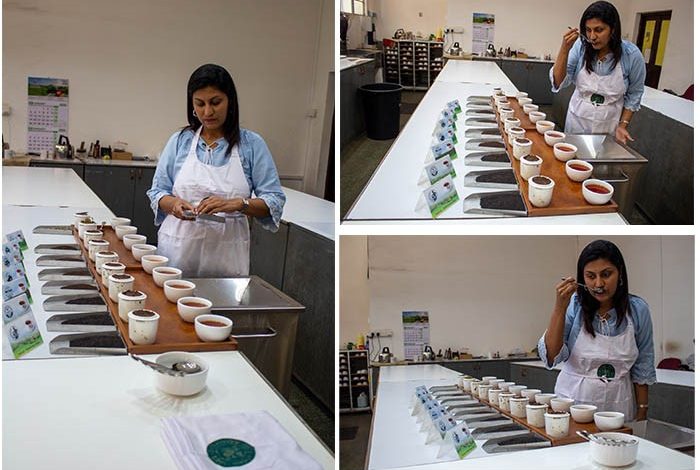
Professional tea tasters safeguard the quality and global reputation of Ceylon Tea. Typically with more than five years’ experience, tasters assess colour, aroma, flavour, and mouth feel across black, green, white, and specialty teas.
“Tea tasters are the guardians of quality, ensuring that every cup maintains the distinctive character and consistency of Ceylon Tea.”
Their expertise is crucial to sustaining the international reputation of Sri Lanka’s teas.
The Evaluation Process
Tea tasting is conducted through organoleptic evaluation, engaging all five senses. Tasters assess:
- Dry Leaf: Colour, evenness, hardness, tips, absence of impurities
- Infusion: Colour, brightness, uniformity
- Tea Liquor: Colour, brightness, body, distinctive character, flavour
Tastings are performed under 1,000 lux lighting. Samples follow ISO 3103 preparation standards, and evaluations comply with Sri Lanka Tea Board and international specifications.
Regional Teas of Sri Lanka
Tea-growing areas are classified by elevation:
- Low Grown: Sea level to 2,000 feet
- Mid Grown: 2,000 to 4,000 feet
- High Grown: Above 4,000 feet
Seven regions produce distinct teas: Ruhuna, Sabaragamuwa, Kandy, Dimbula, Nuwara Eliya, Udupussellawa, and Uva. Each region’s teas are influenced by climate, altitude, rainfall, soil, and manufacturing methods.
Regional Characters:
- Ruhuna: Bold, distinctive
- Sabaragamuwa: Stylish, leafy, smooth
- Kandy: Full-bodied
- Dimbula: Refreshing, mellow
- Nuwara Eliya: Delicate, fragrant
- Udupussellawa: Tangy
- Uva: Aromatic, exotic
Manufacturing and Seasonal Excellence
Black tea is produced using Orthodox, Orthodox Rotovane, and CTC (Crush, Tear, and Curl) methods. Green teas are graded according to leaf style and processing.
Two main seasons enhance quality:
- Dimbula Season: January–March
- Uva Season: July–September
Teas during these periods develop stronger flavours and often achieve premium auction prices.
Regional Tea Profiles
- Ruhuna (Low Grown): Strong, deep red liquor; popular in Middle East
- Sabaragamuwa (Low Grown): Smooth, mellow liquor; Middle East favorite
- Kandy (Mid Grown): Full-bodied, balanced; popular locally and in Europe
- Dimbula (High Grown): Bright, orange-red liquor; floral notes; prized locally and in Europe
- Nuwara Eliya (High Grown): Light, greenish leaves; delicate aroma; highly valued in Europe, China, Japan
- Udupussellawa (High Grown): Light strength, good colour; ideal for blends
- Uva (Mid & High Grown): Distinctive wintergreen flavour; premium auction prices; favored in Japan, China
Economic and Cultural Significance
Ceylon Tea is a major contributor to Sri Lanka’s economy, providing employment to over one million people across plantations, smallholdings, factories, transport, and regulatory sectors.
Tea reflects generations of expertise and is deeply embedded in Sri Lanka’s cultural identity. It is a symbol of hospitality, respect, and social connection, often featured at diplomatic events, exhibitions, and official functions.
Tourism and Industry Engagement
Tea estates, factories, colonial-era bungalows, and museums in Nuwara Eliya, Dimbula, and Kandy attract local and international visitors. Tours offer first-hand experience of plucking, manufacturing, and professional tasting.
Collaboration between estates, exporters, hotels, tour operators, and government institutions has positioned Ceylon Tea as a premium lifestyle product. Festivals, exhibitions, tasting sessions, tea lounges, and pairing events further engage consumers.
Global Trust and Sustainability
Ceylon Tea is exported to over 140 countries, with the Lion Logo guaranteeing 100 per cent Sri Lankan origin and compliance with quality standards. Production follows ISO requirements and Sri Lanka Tea Board regulations.
The industry is recognised for ozone-friendly practices and environmental responsibility. Ethical and sustainable production reinforces global trust and meets consumer demand for responsibly sourced products.