
Sri Lanka Can Cash In on a Global Shift Toward Long-Stay Living
Sri Lanka’s tourism strategy has long relied on short-stay visitors. Attracting financially secure long-term residents could generate far greater and more stable economic benefits for the country.
Sri Lanka stands at a critical moment in shaping the future of its tourism industry. While visitor arrivals are gradually increasing, the overall economic value generated by tourism remains far below its potential. The country continues to rely heavily on short-stay mass tourism, a segment that often brings modest per-visitor spending and fluctuating revenue.
However, global developments are creating a new opportunity that Sri Lanka has yet to fully recognise.
Recent geopolitical tensions in the Middle East, particularly the conflict between Iran and Israel, have once again highlighted the vulnerability of certain regions long considered stable. Even highly developed Gulf states such as the United Arab Emirates have experienced incidents affecting critical infrastructure, raising concerns among affluent residents and international investors.
For decades, Gulf economies successfully attracted wealthy expatriates by offering favourable tax regimes, residency privileges and a secure business environment. Yet the changing global landscape is prompting many financially secure individuals to reconsider their long-term residence options.
This shift presents Sri Lanka with a valuable strategic opening.
A Growing Global Trend
Around the world, a growing category of people can be described as financially secure migrants. These individuals possess significant savings, pensions or investment capital and are searching for peaceful, secure and affordable places to live.
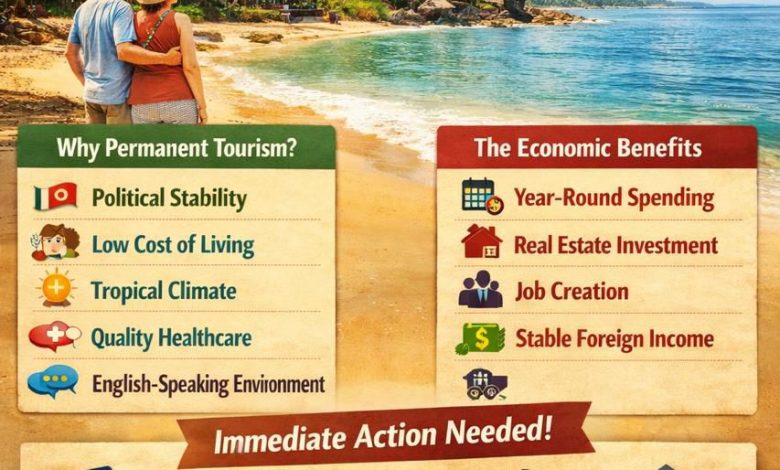
Sri Lanka offers several natural advantages that align well with these expectations:
- Political neutrality
- A tropical climate and natural beauty
- Relatively low living costs
- An English-speaking environment
- High medical standards
- A culture known for hospitality and openness
Despite these strengths, Sri Lanka has not yet positioned itself as a destination for long-term international residents.
Countries such as Malaysia and Thailand have already introduced successful programmes encouraging foreign retirees to settle permanently or semi-permanently.
Sri Lanka should not miss this opportunity again.
Permanent Tourism as an Economic Engine
A modern tourism strategy should embrace the concept of permanent tourism. Instead of focusing exclusively on short-term visitors, the country could attract long-term residents who contribute continuously to the local economy.
Senior citizens from Europe represent a particularly promising group. Countries such as Germany, Switzerland and Austria have millions of retirees with stable monthly pensions and considerable savings.
If Sri Lanka were able to attract even 80,000 long-term senior residents, the economic impact could be comparable to the spending generated by approximately 2.5 million short-stay tourists each year.
The reason is simple. Permanent residents spend money throughout the year rather than only during a brief holiday.
They typically:
- Purchase or lease property
- Employ local staff and services
- Pay for healthcare and wellness services
- Invest in small businesses
- Transfer pensions and savings into local financial institutions
Such activity would generate stable foreign currency inflows, something Sri Lanka urgently needs.
The Challenge of Bureaucratic Delay
Unfortunately, Sri Lanka has historically been slow in implementing new tourism initiatives.
Concepts such as marina development, nautical tourism and long-stay retirement programmes have been discussed for years, often supported by feasibility studies. Yet progress has frequently been delayed by administrative processes and policy uncertainty.
In today’s rapidly changing global environment, hesitation can mean losing opportunities to competing destinations.
Countries seeking affluent retirees are acting quickly and strategically.
Sri Lanka must demonstrate the same sense of urgency.
Practical Steps Forward
Several practical policy measures could quickly position Sri Lanka as an attractive destination for international retirees.
A Special Retirement Visa
Introduce a renewable long-term visa — for example, a ten-year retirement visa — for foreigners aged 55 and above.
Encouraging Pension Transfers
Create incentives for retirees to transfer pension income and savings into Sri Lankan banks.
Targeted Tax Incentives
Offer tax advantages for retirees who invest in property or transfer funds to the country.
Simplified Property and Investment Regulations
Provide clear and secure long-term leasing or approved ownership structures for foreign residents.
Efficient Administration
Ensure that retirement visa applications and related approvals can be processed within thirty days rather than several months.
A Moment That Should Not Be Missed
Sri Lanka already possesses many of the qualities retirees from Europe and other regions are seeking: natural beauty, a warm climate, welcoming communities and a relaxed lifestyle.
What is needed now is political determination and administrative efficiency.
The global environment is evolving rapidly. Wealthy individuals are increasingly searching for safe and stable places to live, invest and spend their retirement years.
Sri Lanka can either seize this opportunity — or watch other countries move ahead.
Permanent tourism has the potential to become one of the most stable and sustainable pillars of the national economy.
The opportunity exists today. What remains is the will to act.
The writer is Dr. Dietmar Doering, Tourism & Investment Promoter for Sri Lanka, based at Aquarius Residences in Marawila.