

Gunathilaka and His Music: A Journey from Sri Palee to Shantiniketan
 Sri Palee College in Horana has long been recognised as a centre of progressive education in Sri Lanka, inspired by the artistic philosophy of India’s Shantiniketan. Its founder, Wilmot A. Perera, returned from visiting Rabindranath Tagore deeply impressed by the holistic environment where academic learning blended with music, dance, literature, crafts, and a close relationship with nature. Determined to bring this spirit to Sri Lanka, Perera established Sri Palee College and invited Tagore himself to lay the foundation stone—an event that marked the beginning of a strong cultural connection between the two institutions. Early exchanges of teachers and students helped embed Shantiniketan’s educational philosophy into the life of Sri Palee.
From the very beginning, the arts were not optional at Sri Palee—they were central. Each school day began at the Upasana Maluwa, a tranquil clearing surrounded by trees. Students assembled in the Upasana Perahera, a slow, meditative four-abreast procession, singing the school anthem together before pausing at Nimaline Hall to sing the national anthem with dignity and stillness. This ritual reflected the school’s belief in discipline expressed through calmness, devotion expressed through sincerity, and education enriched by culture. Within this nurturing and artistic setting, Weerasena Gunathilaka grew, absorbing the aesthetic values that would shape his life.
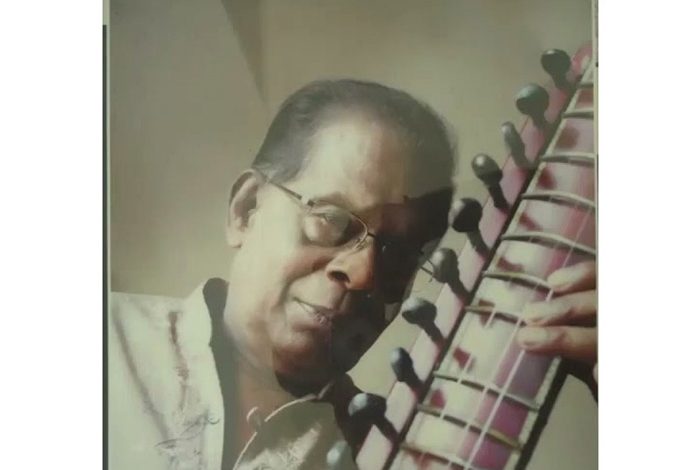
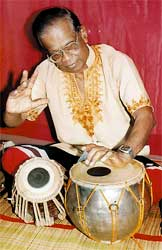
Gunathilaka showed remarkable musical talent from a young age. In the early 1970s, he was also an active sportsman, reflecting Sri Palee’s emphasis on balanced development. His dedication to music led him to Visva-Bharati University, Shantiniketan, where he studied esraj and tabla. There he became one of the most distinguished students in his cohort and earned a scholarship for his achievements. When he later returned to perform at Shantiniketan, his former teachers and colleagues organised his travel—evidence of the deep respect he continued to inspire.
His singing voice is celebrated for its clarity, emotional depth, and refined discipline. He was also an accomplished serpina player, known for his musical sensitivity and versatility. The eminent musicologist Lionel Edirisinghe remarked that Gunathilaka’s voice possessed qualities comparable to those of leading Indian classical vocalists. Beyond performance, he contributed significantly to research and documentation in music. His close association with W. B. Makuloluwa, the pioneer of Sri Lankan folk music and theatre, stands as a notable chapter of his career; he participated in all of Makuloluwa’s major productions.
Among his most cherished contributions is the song “Pareiane Warella.” Though not created with political intention, it resonated deeply with the youth of its era, subtly reflecting the social mood of the time. Its lasting popularity is due to its originality, strong musical structure, and the heartfelt quality of Gunathilaka’s performance—qualities that continue to attract listeners today.
Professionally, Gunathilaka served in multiple influential roles. He taught at Sri Palee College, contributed to music programming at the Sri Lanka Broadcasting Corporation, and later joined the Polgolla Teachers’ Training College in Kandy as a lecturer. It was here that he met Nalinie, who became his lifelong partner in the arts and in education. She had originally trained in traditional dance and lectured in the subject, and later served as an Advisory Lecturer in Primary Education in several teacher-training colleges after completing her postgraduate degree in Primary Education. Their shared dedication to music, dance, and teaching formed a meaningful and enduring partnership.
Gunathilaka comes from a family with strong artistic inclinations. His sister Soma Gunethileke is a talented music teacher, while Karuna Gunethileke, who had studied music though later taught other subjects, passed away a few years ago. Both sisters played important roles in shaping his early artistic environment. Together, Gunathilaka and Nalinie raised two sons, Isuru (working in the shipping sector) and Nuwan (working in IT), both of whom maintain a lasting appreciation for the arts.
A significant part of Gunathilaka’s contribution lies in his research on Sri Lankan folk music. He travelled widely to document traditional songs passed down through oral tradition, preserving them with great care. By combining field research with performance practice, he helped students and audiences gain a deeper understanding of Sri Lanka’s musical heritage. Even today, despite his advanced age, he remains active as a mentor, guiding young musicians and continuing to embody the artistic values fostered at both Sri Palee and Shantiniketan.
Gunathilaka often reflects on the importance of maintaining Sri Palee’s unique educational character. Though the school remains respected and successful, sustaining its Shantiniketan-inspired model—particularly traditions such as the Upasana Perahera—requires consistent institutional support and thoughtful attention. Preserving these practices is vital for future generations to experience the creative and contemplative environment envisioned by Wilmot A. Perera.
To many, Weerasena Gunathilaka stands as a living bridge between Sri Palee and Shantiniketan. Through decades of teaching, performing, researching, and nurturing young artists, he has strengthened the cultural connection between the two institutions. His lifelong dedication ensures that Sri Palee College continues to be a place where creativity and the arts thrive for generations to come.