

El Niño, Climate Change and Future of Sri Lanka Tourism

By Prof. Suranga Silva DAC, Ms. Dulaja Silva DA and Mr.Kavinda MSP
Global Impact of El Niño and Climate Change on Global Tourism
El Niño, a naturally recurring Pacific Ocean warming pattern, is being intensified by human-driven climate change. The current El Niño 2026 occurrence ranks among the strongest on record, with temperature anomalies exceeding 3-4°C and worsening droughts, floods, cyclones, and heat globally (ILO, 2026).
The Economic Loss:
- The economic toll is becoming severe and long-lasting. It was cost US$ 4.1-5.7 trillion in global income during 1982-83 and 1997-98, and the 2026 El Niño itself is projected to cause US$ 680-686 billion in year-one losses, compounding to US$3.1 trillion over five years.
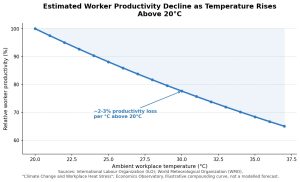
- Heat stress from these events is significantly cutting workforce productivity by 2-3% per degree above 20°C, with the ILO projecting a 2.2% loss of global working hours by 2030 (US$ 2.4 trillion), hitting South Asia hardest at a projected 5% loss.
- Ecologically, the 1982-83 El Niño destroyed 95-99% of Galápagos coral reefs, and tourism economies remain especially vulnerable causing up to US$ 11.5 billion in tourism losses, with shoreline erosion spiking 76% above normal during the 2015-16 event.
Table 1: Key global indicators of El Niño and climate change impact
| Indicator | Value |
|---|---|
| Global economic loss, 1982-83 El Niño | US$4.1 trillion |
| Global economic loss, 1997-98 El Niño | US$5.7 trillion |
| 2026 Super El Niño, year-1 loss | US$680-686 billion |
| 2026 Super El Niño, 5-yr cumulative loss | US$3.1 trillion |
| Worker productivity loss | 2-3% per °C above 20°C |
| Global working hours lost to heat stress by 2030 | 2.2% (≈80 million FTE jobs; US$2.4 trillion) |
| South Asia working hours lost to heat stress by 2030 | 5% (≈43 million FTE jobs) |
| Coral mortality, 1982-83 El Niño | 95-99% |
| Shoreline retreat, 2015-16 El Niño | 76% above normal winter erosion rate (US West Coast) |
| Immediate economic damage, single El Niño event | Up to US$11.5 billion |
Sources: ILO; WMO, Climate Change and Workplace Heat Stress; Economics Observatory
Figure 1: Rising temperature (above 20°C) and Heat-driven productivity loss.
Impact of El Niño on Sri Lanka Tourism and Other Tropical Island Economies:
Tourism is a major pillar of Sri Lanka’s economy (~10% of GDP, 250,000 direct jobs and 1 million indirect), but the country ranks 124th on the ND-GAIN Climate Vulnerability Index, facing coastal erosion, coral degradation, and shifting monsoon patterns.
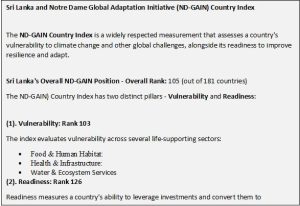
Sri Lanka and Notre Dame Global Adaptation Initiative (ND-GAIN) Country Index
The ND-GAIN Country Index is a widely respected measurement that assesses a country’s vulnerability to climate change and other global challenges, alongside its readiness to improve resilience and adapt.
Sri Lanka’s Overall ND-GAIN Position – Overall Rank: 105 (out of 181 countries)
The ND-GAIN) Country Index has two distinct pillars – Vulnerability and Readiness:
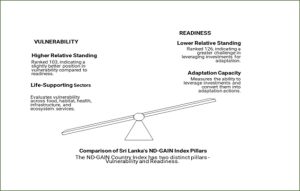
(1). Vulnerability: Rank 103
The index evaluates vulnerability across several life-supporting sectors:
- Food & Human Habitat:
- Health & Infrastructure:
- Water & Ecosystem Services
(2). Readiness: Rank 126
Readiness measures a country’s ability to leverage investments and convert them to adaptation actions. Readiness is measured across three areas:
- Economic Readiness
- Governance Readiness
- Social Readiness
ND-GAIN places Sri Lanka in the lower-left quadrant of the ND-GAIN Matrix, indicating that Sri Lanka’s current climate vulnerabilities are relatively manageable compared to the world’s most at-risk nations, but its readiness to adapt is alarmingly low.
The El Niño – 2016-17 alone affected over 2 million people through flooding and drought. Its central highlands and Indian Ocean location do offer some natural buffering, though this advantage remains under-marketed.
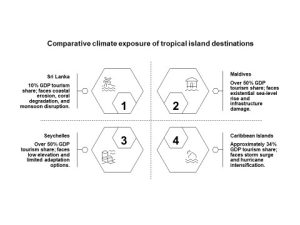
Compared to peer island economies, Sri Lanka is relatively less exposed. The Maldives and Seychelles face existential risk with tourism exceeding 50% of GDP each (the Maldives seeing 90% of resorts report erosion, 60% infrastructure damage), while Caribbean SIDS (~34% GDP dependency) rely on inland diversification to manage storm risk.
Sri Lanka Readiness:
Sri Lanka’s lower tourism with GDP dependency and moderating geography make it structurally safer than these peers but its smaller tourism revenue base and tighter public finances also leave it with far less capacity to fund the kind of large-scale adaptation infrastructure that Maldivian resorts self-finance.
Table 2: Comparative climate exposure: Sri Lanka with other tropical island destinations
| Country | Tourism Share of GDP | Key Climate Exposure | Significant Response |
| Sri Lanka | ≈10% (US$2bn/yr; 250,000 direct jobs, ≈1 million indirect jobs) | Coastal erosion, coral degradation, weakened monsoon, hill-country weather disruption; Ranked 124th on ND-GAIN Index | National Adaptation Plans (2016-25, 2025-34, 2026-35); Climate Prosperity Plan; SLYCAN Trust risk mapping |
| Maldives | Over 50% of GDP | Existential sea-level rise; Over 90% of resorts report beach erosion; 60% report infrastructure damage; Average island elevation ≈1.5m | Tourism Climate Action Plan (2023): reef restoration, coastal erosion control, sustainable water management |
| Seychelles | Over 50% of GDP | Low elevation, high tourism dependence; Limited adaptation options (sea walls, coastal armoring) | Marine Protected Area expansion; Regional climate finance mobilization |
| Caribbean Islands | ≈34% of GDP | Storm surge, coastal erosion, hurricane intensification | Inland attraction diversification; Nature-based coastal defenses |
Figure 2. Tourism dependency compared across Sri Lanka and other tropical island economies.
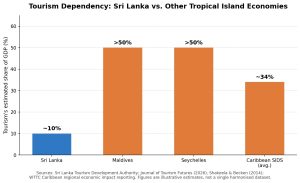
Sources: Sri Lanka Tourism Development Authority; WTTC-2025 and other reports
Climate Resilient Tourism and Global Travel & Tourism Competitiveness:
Sri Lanka’s structural readiness for climate-resilient tourism can be read through the World Economic Forum’s Travel & Tourism Development Index (TTDI), successor to the TTCI and, alongside the ND-GAIN Index, one of the few globally comparable benchmarks of a destination’s capacity to develop tourism sustainably.
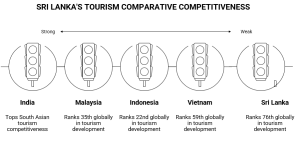
In the 2024 edition, Sri Lanka ranked 76th of 119 economies with a score of 3.69 — flat in absolute terms since 2019, but one place lower relatively as competitors advanced faster. Regionally it trails Vietnam (59th), Indonesia (22nd), and Malaysia (35th), though it leads most South Asian neighbours except India (39th), which tops the sub-region.
The score’s composition matters more than the rank. Sri Lanka performs well on price competitiveness and the T&T Socioeconomic Impact pillar — reflecting tourism’s outsized share of national income and employment — but poorly on tourism services and infrastructure, cultural resources, and non-leisure resources, the categories most dependent on sustained public investment rather than natural endowment. The gap is therefore not a demand-side problem of weak attractions or affordability, but a supply-side one as well. The infrastructure and services built around those attractions remain underdeveloped.
Environmental sustainability is the most persistent weakness, recurring across successive editions. Sri Lanka ranked as low as 103rd on this pillar, a decline linked partly to forest cover falling from 54% to 29% of land area over two decades with direct consequences for hill-country ecosystems, watershed stability, and the microclimates on which much inland tourism depends.
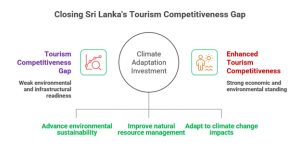
Examining together, strong economic contribution alongside weak environmental and infrastructural readiness signals that Sri Lanka’s competitiveness gap is fundamentally a supply-side and environmental-governance problem.
This is precisely what well-targeted, bankable, UN Tourism-aligned climate adaptation investment could close. Each additional TTDI point earned through reforestation, ecosystem restoration, or climate-resilient infrastructure would lift both environmental sustainability standing and overall competitiveness of Sri Lanka Tourism provided that a rare alignment where climate policy and economic policy point in the same direction of the country.
Global Best Practices and Lessons for Sri Lanka Tourism
Drawing on the organizational frameworks of UN Tourism and the World Travel & Tourism Council (WTTC), and on the destination-level experience of the Maldives, New Zealand, Costa Rica and the Caribbean Islands, Sri Lanka Tourism has to seriously concern the followings:
a) Sri Lanka must position adaptation planning as an investable proposition. The UN Tourism’s 2025 sustainable investment guidelines advocate a “Bankable” framing of climate adaptation, structured across governance, economic, socio-cultural and environmental dimensions.
The National Adaptation Plans and Climate Prosperity Plan of Sri Lanka would benefit from comparable repositioning. it should be reformulated not merely as policy instruments but as investment-ready propositions capable of attracting the donor and climate-finance interest as it has underwritten reef restoration initiatives in the Maldives.
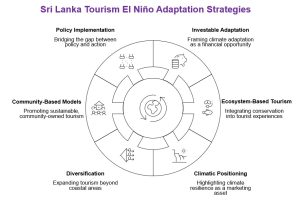
b) It is an instrumental to re-conceptualizing the ecosystem protection as a visitor-facing and involved product development. The Maldivian model demonstrates that reef restoration can function as a revenue-generating activity rather than a purely defensive one, with protected reef systems sustaining the dive tourism that, in turn, finances further conservation.
Sri Lanka’s coral reefs, mangrove systems and hill-country ecosystems are presently treated primarily as scenic backdrop, recasting them as active conservation experiences such as guided restoration dives or mangrove-planting programmes for tourists themselves, then which would replicate this self-sustaining model.
c) Market climatically must be used to moderate natural features as resilience assets rather than an uncommunicated advantage. New Zealand’s positioning of its temperate, low-density landscape as evidence of both climatic and governmental resilience offers a transferable model.
Sri Lanka can experience during the current Super El-Niño cycle in the central highlands together with the relatively moderated exposure which must be systematically communicated to climate-conscious travelers.
d) Diversification of Sri Lanka Tourism away from coastal concentration must be highly strategic. Caribbean Small Island Developing States have pursued inland attraction development as a means of reducing pressure on climate-vulnerable coastlines.
Sri Lanka’s hill country, which already functions as a natural counterweight to beach-centered tourism, must be deliberately developed as a parallel pillar of the national tourism offering, thereby reducing concentration risk in coastal zones most exposed to sea-level rise and coral bleaching.
e) Sri Lanka must embed low-impact and high-value, community-based operating models. Costa Rica’s eco-lodge and permaculture-oriented tourism sector illustrates how resilience can be embedded within the tourism product itself rather than appended to it.
Sri Lankan Tourism should promote hill-country and rural areas to adopt comparable community-owned, low-impact models, treating sustainability as a structural feature of its businesses rather than a supplementary consideration.
f) The country must address the persistent gap between policy formulation and implementation. The limited real-world impact of UN Tourism’s Glasgow Declaration on hotel-sector emissions reflects an execution gap analogous to the one Sri Lankan officials have themselves identified within national policy.
Key priority should accordingly be given to a limited set of measurable, adequately funded, and consistently monitored interventions in preference to an expanding portfolio of high-level planning in tourism development.
g) One of the most effective measures must be the improvement of extend resilience planning to the trained and retained workforce. Given ILO projections regarding heat-driven productivity and labour-hour losses across South Asia, occupational health protocols, flexible working arrangements during extreme heat events and Green HR practices should be regarded as integral components of durable resilience, on comparable footing with infrastructure investment.
Taken together, these recommendations point to a single overarching conclusion:
Although Sri Lanka is, on current evidence, less existentially exposed to El Niño and climate change than tourism-dependent peers such as the Maldives or Seychelles, converting this relative advantage into a durable competitive strength will require deliberate branding, strategic diversification and investable adaptation planning. Above all, the disciplined implementation of measures reaching the expected achievements in developing resilience against the impact of El Niño must be committed as a nation.
Selected References
- International Labour Organization. (2019). Working on a warmer planet: The impact of heat stress on labour productivity and decent work. https://www.ilo.org/publications/major-publications/working-warmer-planet-effect-heat-stress-productivity-and-decent-work
- Ministry of Tourism, Republic of Maldives. (2023). Maldives tourism climate action plan. https://resources.tourism.gov.mv/wp-content/uploads/2024/09/MALDIVES-TOURISM-CLIMATE-ACTION-PLAN.pdf
- Ministry of Tourism, Republic of Maldives. (2023). Fifth tourism master plan 2023–2027. https://climate-laws.org/document/fifth-tourism-master-plan-2023-2027_c5d7
- Notre Dame Global Adaptation Initiative. (2024). ND-GAIN country index. University of Notre Dame. https://gain.nd.edu/our-work/country-index/
- Sri Lanka Tourism Development Authority. (2022). Strategic plan for Sri Lanka tourism 2022–2025. https://www.sltda.gov.lk/storage/common_media/Sri_Lanka-Final_V6_Edited850147500.pdf
- UN Tourism. (2024, March). Policy guidance to support climate action by national tourism administrations. https://doi.org/10.18111/9789284425365
- UN Tourism. (2025, March). Sustainable tourism investment guidelines. https://www.unwto.org
- World Travel & Tourism Council. (2024). Nature positive vision for travel & tourism: Positioning T&T as a guardian of nature. https://wttc.org/sustainability
- World Travel & Tourism Council & Greenview. (2025). WTTC-Greenview global ESG policy tracker. https://wttc.org/sustainability/policy-tracker