
Sri Lanka Tourism: Beyond and Between the Numbers
“Visitors Arrive- Revenues Leave” Key Evidence-Based Findings Revealing the Leakages of Tourism Revenue in Sri Lanka


By
Prof DAC Suranga Silva
Professor in Tourism Economics, University of Colombo, Sri Lanka
Emails: drsuranga@econ.cmb.ac.lk; drsuranga3@gmail.com
Conventional Mass Tourism often pressures natural resources and bypasses local communities and their wellbeing. Right application for embracing sustainable and inclusive tourism is to transform our tourism into a well-balanced development by protecting the environment, empowering local people and generating meaningful economic benefits to the country.
Furthermore, inclusiveness of tourism ensures the shared benefits among the responsible stakeholders and provides assurance of fair accessibility for all. Reducing the tourism income leakage ensures that tourism revenue ensures to make the best possible value-added contribution to Sri Lankan economy steering toward the making a thriving nation and happy life for Sri Lankans.
The right combination of Such fundamental principles directs Sri Lanka into the accurate pathway for its tourism development through the Positive Multiplier Effect and Impactful Ripple Effect, which can ensure an inclusive and sustainable tourism development in Sri Lanka.
Multiplier Effect and Ripple Effect
The tourism multiplier effect in Sri Lanka can significantly boost the economy by circulating tourist spending through multiple sectors like hospitality, transportation, retail, apparel and agriculture etc, by ensuring earning tourism earnings, contributing substantially to the country’s GDP and generating employment & income opportunities across various communities.
The ripple effect ensures these economic gains to promote inclusive and sustainable development by involving local SME businesses and even marginalized communities which can encourage pro-poor tourism development.
Together, these effects create a powerful, positive cycle where tourism not only drives economic growth but also uplifts society and safeguards the unique natural and cultural assets of Sri Lanka. This holistic impact is key to achieving long-term inclusive and sustainable tourism development, positioning Sri Lanka as a competitive and responsible global destination.
Visible with Massive Hidden in Sri Lanka Tourism Economy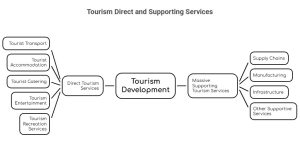
Contribution of tourism into our economy can be explained through two major layers:
(1) Visible Direct Tourism Services and (1) Hidden Supporting Tourism Services.
Both layers are essential for deciding its net economic contribution to Sri Lankan economy.
The visible tourism sector cannot function without the support of its hidden foundational services.
Invisible Over Visible Tourism Economic Value
The true economic value of tourism contribution in Sri Lanka goes beyond direct tourist services, extending through a broad interact of supporting businesses connected by Backward and Forward Linkages.
Backward and Forward Linkages
Backward linkages of Sri Lanka Tourism involve the industries supplying goods and services to the tourism industry, such as agriculture, manufacturing, transportation, and utilities, which generate upstream demand and stimulate output in these sectors.
Forward linkages connect tourism outputs to sectors like retail, entertainment, and financial services that further distribute tourism benefits and create wider economic activity.
Together, these effects create a powerful and positive cycle where tourism not only drives economic growth but also uplifts the economy and society in Sri Lanka. This holistic impact is key to achieving long-term inclusive and sustainable tourism development, positioning Sri Lanka as a competitive global destination.
Inclusive Tourism Growth
The strong backward and forward linkages of tourism industry ensure that economic benefits spread far beyond frontline services in hotels and travel.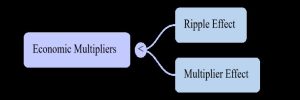
Instead of confining such benefits to a narrow band of tourism, opportunities for income generation across multiple sectors throughout the community must reach a much wider range of local people and businesses to ensure the Inclusive Economic Growth of the industry.
Ripple Effect and Multiplier Effect
Sri Lanka Tourism must ensure that tourists’ expenditure creates ripple effects throughout the economy. Similarly, the industry’s Multiplier Effect should be directed to effectively circulate this tourism expenditure within the economy of Sri Lanka. Each dollar from tourist spending must generate direct impact (hotel revenue), indirect impact (suppliers and service providers) and induced impact (employees spending wages) locally.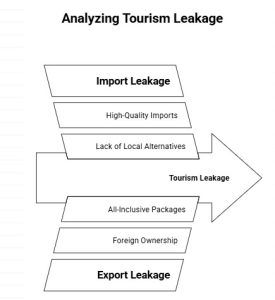
A stronger multiplier means more tourism revenue stays in Sri Lanka, benefiting local hotels & guesthouses, Sri Lankan farmers, artisans, transport providers and communities from coast to hill country and from urban to rural areas and so on. This should prevent of creating a weaker multiplier through tourism leakage, where revenue escapes through foreign-owned chains, imported goods and offshore operators, reducing the potential economic benefit of tourism development to Sri Lankan economy.
Tourism Leakage: “Visitors Arrive- Revenues Leave”
Tourism leakage refers to the process where revenue generated by tourism in a specific destination “leak” out from to the rest of the world, instead of circulating within the destination itself. In other words, it is the revenue generated by the tourism industry of a destination does not end up benefiting the same destination or the host country.
This leakage creates a situation where a country may host millions of visitors yet see very little real economic gain.
This phenomenon is particularly significant in developing countries, where it is estimated that between 40% to 80% of tourism revenue can leave the country.
There are two primary types of tourism leakages:
Tourism Import Leakage: This occurs when a destination must buy goods and services from other countries to meet the demands of tourists.
Tourism Export Leakage: This happens when profits from tourism-related businesses are sent back to a different country. This is common with foreign-owned hotels, tour operators and airlines etc. “All-inclusive” packages designed by international tour operators create a very little revenue contribution to Sri Lanka as a host-destination.
Major Causes for Tourism Leakage
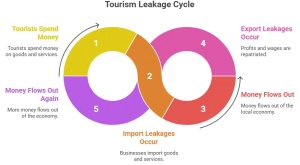
- Foreign Ownership.
- “All-Inclusive” Packages
- Import Dependence
- Foreign Tour Operators & Airlines
- External Debts taken to build tourism infrastructure
Socio-Economic Impacts of Tourism Leakage
Severity of Economic Hemorrhage of Tourism Revenue must be clearly identified. One of the single greatest obstacles to maintaining value added contribution of tourism industry retaining tourism is economic leakage, where the income generated through tourism in Sri Lankan economy is vanishing due to the imported goods & services and profit repatriation etc. The high rate of tourism leakage has serious negative consequences for a host destination like Sri Lanka: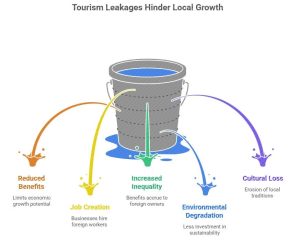
- Limited Economic Development through Weakening Tourism Multiplier Effect
- Unequal Wealth Distribution due to the low-skilled, low-wage service jobs that remain for locals
- High profits earned by foreign owners and expatriate managers
- Cultural erosion & resentment.
- Lack of Community Empowerment and High Social Polarization
Critical Importance of Minimizing Tourism Leakages in Sri Lanka Tourism
- The Effectiveness of Tourism Engine in creating economic prosperity is successful only if the generated tourism income in Sri Lanka stays within our economy and continues such income in circulating among local businesses and communities across the country.
- If tourism revenue flows out to external suppliers, foreign-owned companies or imported goods the potential benefits of tourism will be unexploited and the Multiplier Effect gets weakened severely.
- Anyway, the economic leakage of the industry can be meant as a loss of tourism revenue to Sri Lanka. This means that even if Sri Lanka Tourism attracts a high number of tourists, their spending might not make any considerable benefit to the local operators of the industry and to local communities involved with the industry at all.
From Volume-Driven Approach to Value-Driven Model
At present, Sri Lanka is to change its strategic direction. Transformation from a Volume-Driven Approach to a Value-Driven Motel is on the way through a definitive plan to create an inclusive and sustainable tourism development in Sri Lanka.
A successful strategy cannot be built on aspiration alone. It must be grounded in a clear-eyed identification of this most pressing challenge. Sri Lanka will have to leverage its non-replicable strategic approaches to move beyond the traditional metric of tourist arrivals. Instead, it should prioritize the depth and quality of economic impact of such tourist arrivals, more specifically through the impact of tourism benefiting entire communities, protecting natural and cultural heritage and building long-term prosperity rather than generating short-term revenue spikes.
Key Evidence-Based Findings on the Severity of Leakage of Tourism Revenue in Sri Lanka
According to the findings of Key Informants Interviews (KIIs) conducted by the Students of Masters in Tourism Economics and Hotel Management (MTEHM), University of Colombo as their pilot research study, the leakage of tourism revenue is significant and severe, more specifically in the premium segments of the industry, where reliance on imports is highly alarming, more specifically in the higher graded hotels of different categories.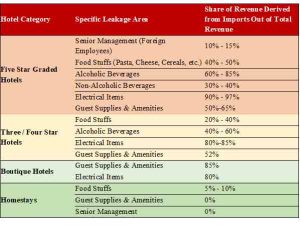
The data reveals a critical error in our current strategy. For every dollar earned in the premium sector, as much as 70%-80% can immediately exit from the country for alcoholic beverages alone and that has an insignificant revenue circulation through local markets, local employment beyond their basic service roles, consequently, a trivial contribution to generate the multiplier effects of tourism and spill-over impact to sustain the industry stakeholders. Conversely, high leakage in tourism income is responsible for declining National Tourism Competitiveness as well.
On the contrary, the homestay sector represents a near-perfect income-circular model, retaining most of the dollars within the community despite the lower income generated through inbound tourism. Furthermore, its dollar cycles deriving through the local economy multiple times by creating employment, supporting small enterprises and building genuine prosperity from the ground up is economically sound, more specifically when considering the fair distribution of such incomes not only at the individual community levels but also regional gaps. Successive rounds of community spending can help to create social capital development as well (e.g. building schools, support farmers and creating sustainable livelihoods rather than enriching foreign shareholders.
| A Comparative Performance Indicators on Sri Lanka Tourism | |||||||
| Index | Sri Lanka | India | Thailand | Singapore | Malaysia | Indonesia | Vietnam |
| Ease of Doing Business (2024) | 99th | 40th | 21st | 1st | 24th | 73rd | 70th |
| Global Travel and Tourism Development Index (TTDI) (2024) | 76th | 45th | 33rd | 19th | 25th | 22nd | 54th |
| Import Dependency Index (Latest available) | High | Moderate | Moderate | Low/Moderate | Moderate | Moderate to High | Moderate |
| Hotel Price Competitiveness Index (2024) | Mid to Low | High | Moderate | High | Moderate | High | Moderate |
Source: Author compilation from different data sources
Plugging the Leak: Closing the Loops and Creating Circulation of Tourism Prosperity
For minimizing tourism revenue leakages, three major interconnected strategic approaches can be highlighted:
- Value Capturing for Maximize Revenue Retention
- Introducing a strategic shift focusing from visible tourism assets to the entire tourism value chain
- Creating different integrated tourism development programmes such as a ‘Farms-to-Hotels National Programme connecting hotels directly with Sri Lankan farmers and producers.
- Boosting local manufacturing of guest amenities and processed foods to replace critical imports
- Empowering community-led tourism enterprises through accessible credit, skills training, and marketing support—ensuring rupees stay and circulate within Sri Lanka.
(2) Value Sharing for Inclusive Tourism Growth
- Introducing systematic approaches to distribute tourism benefits fairly and equitably across sectors and communities.
- Strengthening the linkages between tourism and agriculture, manufacturing and services.
- Developing distinctive niche products—agrotourism, wellness tourism, cultural immersion.
- Implementing national hospitality entrepreneurial and management skills to reduce foreign management dependency.
- Establishing a community dividend framework ensuring local commuity benefit directly from revenues generated at natural and cultural heritage sites.
(3) Value Sustaining for Competitive Advantage Through Sustainability Practices
- Position sustainability as Sri Lanka’s competitive edge.
- Launch ‘Circular Tourism Campaign” as an initiation for sustainable practices in tourism.
- Adopt and apply conservation-for-prosperity incentives, policies and regulations that reinvest tourism earnings into protecting natural capital.
- Pursue high-value, low-impact tourism that attracts discerning travelers while safeguarding infrastructure and ecosystems.
- Promote responsible business operators and investors for Inclusive and sustainable tourism development
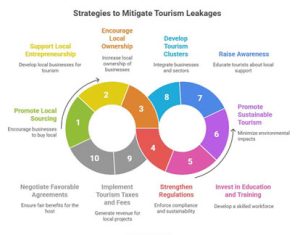
In addition, the effective specific strategies to mitigate tourism leakages in Sri Lanka can be highlighted as the figure below:
The 5 Ps conceptual Framework can also be applied for minimizing Tourism Leakage in Sri Lanka
Synergy of 5Ps
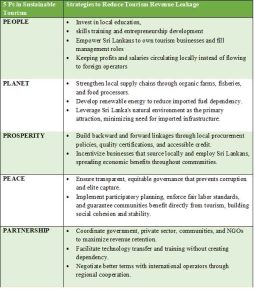
If the right application of 5 Ps (People, Planet, Prosperity, Peace, and Partnership) can create a powerful synergy then it will effectively transform Sri Lankan Tourism from a source of leakage into an engine of creating the industry prosperity. Empowered local communities build and own businesses that source from sustainable Sri Lankan suppliers, by generating inclusive economic growth within equitable, well-governed systems strengthened by strategic partnerships. Tourism revenue no longer escapes offshore but circulates through multiple spending rounds within the economy, amplifying the multiplier effect to its fullest potential.
This integrated approach ensures tourism becomes what it should always have been: a genuine catalyst for broad-based, sustainable development that enriches communities from coast to hill country, protects Sri Lanka’s irreplaceable natural and cultural heritage and builds enduring prosperity for all Sri Lankans, today and for generations to come.
Are Tourism Revenue Leakages Inevitable and Acceptable Trade-offs
| Type of Leakage | Why Inevitable/Acceptable | Strategic Value | Net Benefit to Sri Lanka |
| Foreign Direct Investment (FDI) Returns | · Domestic capital insufficient
· World-class infrastructure requires billions · Investors deserve legitimate returns on risk |
· Attracts FDI in tourism investments
· Builds airports, hotels, resorts beyond local capacity · Creates employment for thousands |
· Infrastructure development and job creation outweigh profit repatriation—without FDI, facilities wouldn’t exist |
| International Brand Licensing & Franchise Fees | · Global brands (Hilton, Marriott, Shangri-La) charge royalties Access to worldwide marketing networks Quality standards and reputation |
· Places Sri Lanka on global tourism map
· Attracts high-value tourists who trust brands · Provides international visibility worth millions |
· Brand recognition and tourist confidence generate far more arrivals and revenue than fees paid out |
| Technology & Management Expertise Payments | · Sri Lanka experienced skilled worker migration
· Advanced hospitality systems require specialized knowledge |
· Skills transfer to local staff Exposure to global best practices· Career development opportunities Technology upgrades |
· Knowledge transfer builds long-term local capacity—temporary payments yield permanent skills |
| Online Booking Platform Commissions | · Platforms (Booking.com, Expedia) reach 100M+ global users
· Convenient, trusted booking systems · Marketing reach local businesses cannot match alone |
· Access to massive tourist markets 24/7 global visibility· Seamless payment systems · Customer reviews build credibility |
· 15-20% commission justified by tourist volumes generated—local businesses gain customers they couldn’t reach independently |
| International Airline Payments | · Foreign carriers provide connectivity to global markets
· Sri Lankan Airlines alone cannot serve all routes · Competition keeps airfares reasonable |
· Direct flights from key markets (Europe, Asia, Middle East)
· Increased accessibility |
· Transportation leakage inevitable goal is to maximize arrivals, not controlling airlines. More tourists = more total spending |
| Imported Specialty Goods | · Some luxury items unavailable locally (specialty wines, certain technologies) International tourists expect familiar products· Quality standards for certain items |
· Meets international tourist expectations
· Maintains service quality and competitiveness · Prevents tourist disappointment |
· Limited imports for guest satisfaction worthwhile focus should be maximizing local sourcing where possible, not eliminating all imports |
| International Marketing & Advertising | · Global tourism campaigns require international agencies
· Overseas media buying expertise |
· Reaches target markets effectively
· Professional campaign quality · Data-driven marketing strategies |
· Marketing spending abroad generates tourist arrivals—ROI justifies the leakage when campaigns are effective |
| Reinsurance & International Insurance | · Large tourism projects require international risk coverage
· Local insurance capacity limited |
· Enables major tourism investments
· Risk mitigation for developers |
· Insurance premiums protect investments and jobs—catastrophic uninsured losses would be far more damaging |
| Foreign Consulting & Design Services | · World-class resort design requires specialized expertise
· Sustainable tourism planning benefits from international best practices · Niche expertise unavailable locally |
· Creates iconic, competitive properties
· International standards of excellence |
· Quality design and planning yield long-term returns—iconic properties become tourist magnets |
| Volume vs. Retention Trade-off | · Mathematical reality: Scenario A: 3M tourists × $200/day × 40% retention = $240M retained Scenario B: 1.5M tourists × $250/day × 70% retention = $262.5M retained Scenario C: 1M tourists × $250/day × 70% retention = $175M retained |
· Strategic leakage acceptance maintains high volumes
· Balanced approach maximizes total retained revenue · Competitiveness to be preserved |
· Moderate leakage with high volume beats low leakage with drastically reduced arrivals—net retained revenue is what matters |
Not all tourism leakage is harmful. Strategic and controlled leakage is inevitable, acceptable and beneficial.
Sri Lanka cannot do all necessary tourism investments and cannot provide facilities to generates tourist volumes that maximize total retained revenue, transfers skills and technology for long-term local capacity building, maintains international competitiveness and service quality and also provides market access beyond local reach.
Therefore, the objective of the policy and decision makers of Sri Lanka Tourism is not for zero leakage, but it should maximize net local benefit through smart partnerships, strategic collaboration and gradual domestic capacity building that strengthens tourism industry in Sri Lanka over time.
Balanced, Smart and Strategic Approach for Reducing Tourism Revenue Leakage
Rather than stopping all kinds of leakages, Sri Lanka should hunt strategic leakages at least short run and must minimize them through the followings:
- Encourage joint ventures between foreign and local partners (technology transfer + local ownership)
- Set local content requirements rather than total bans
- Develop local capacity gradually before restricting foreign participation
- Attract high-value FDI that includes training, technology transfer, and local employment
- Create incentives for foreign operators to source locally rather than punitive restrictions
- Build domestic capability first in supply chains, skills, and capital before reducing foreign participation
- Maintain openness to international brands while supporting local alternatives
Conclusion
Reducing tourism leakage must be gradual, strategic and balanced, but not in “leak-proof” absolute process.
The primary objective of the policy and decision makers must be maximizing net local benefit, which sometimes requires accepting controlled leakage to attract foreign investment, expertise, and tourist volumes that ultimately generate greater overall local revenue than a perfectly “leak-proof” but stagnant tourism sector.
Sri Lanka needs foreign investment and international partnerships, but on the terms that prioritize local participation, facilitate skills transfer and build long-term domestic capacity. The strategic approach is not to create an isolation, but for strategic collaboration that strengthens Sri Lankan ownership, expertise, and economic benefit over time while leveraging global resources for sustainable growth.