

Export Shockwaves Sri Lanka’s Winners, Losers and New Markets
Electronics soared 61%, spices surged and Turkey emerged as a rising market. But apparel and tea slipped as Sri Lanka’s exports reached US$13.61 billion. The race towards US$36 billion has begun.
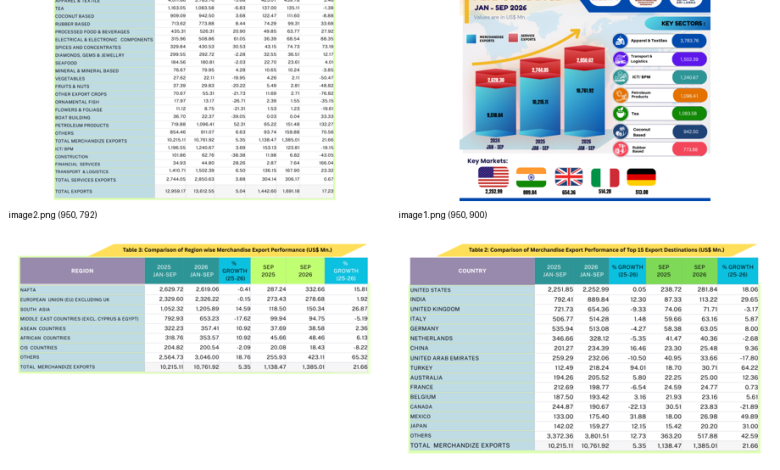
Sri Lanka’s export earnings reached US$13.61 billion during the first nine months of 2026, recording a 5.04% increase over the same period last year. But behind the overall growth lies a changing picture, with some industries making strong gains while established export earners face pressure.
Electrical and electronic components, spices, rubber products and processed foods delivered encouraging results. Apparel and tea, two important contributors to export earnings, recorded declines over the nine-month period. Meanwhile, India overtook the United Kingdom to become Sri Lanka’s second-largest export destination, and Turkey emerged as a market showing particularly strong growth.
The figures released by the Sri Lanka Export Development Board (EDB), based on data from Sri Lanka Customs and the Central Bank of Sri Lanka, show that merchandise exports increased by 5.35% to US$10.76 billion between January and September. Services exports rose by 3.88% to US$2.85 billion.
September brought a stronger performance. Total exports increased by 17.23% year-on-year to US$1.69 billion. Merchandise exports rose by 21.66% to US$1.39 billion, while services exports grew by 0.67% to US$306.17 million.
Electronics leads the charge
One of the most striking developments was the performance of electrical and electronic components. Exports from the sector rose by 61.05% during the first nine months of the year, reaching US$508.86 million.
Insulated wires and cables recorded growth of 82.59%, while switches, boards and panels increased by 31.49% and electrical transformers by 33.46%. Exports of telephone sets and audio/video equipment and parts rose by 234.82%. Boilers, piston engines, pumps and vacuum pumps recorded an even sharper increase of 508.71%.
The sector’s September performance was equally notable, with export earnings rising by 88.35% to US$68.54 million. Insulated wires and cables increased by 114.62%.
These figures point to growing opportunities in manufacturing products that serve international supply chains. Sustaining this progress will depend on the industry’s ability to remain competitive and expand its reach in overseas markets.
Spices, food and rubber add strength
Sri Lanka’s traditional strengths also produced encouraging results in several categories.
Exports of spices, essential oils and oleoresins increased by 30.53% during January–September, reaching US$430.53 million. Pepper exports rose by 61.45% to US$136.26 million, while cinnamon increased by 31.03% to US$221.56 million. Essential oils and oleoresins also recorded growth.
September was particularly strong for spices. Export earnings rose by 73.19% to US$74.73 million. Pepper exports surged by 165.38% to US$23.46 million, while cinnamon increased by 68.27% to US$42.59 million.
Food and beverages recorded 20.90% growth over the nine-month period, reaching US$526.31 million. Processed food exports increased by 34.19% to US$243.28 million, while non-alcoholic beverages grew by 46.78% and animal feed by 13.69%.
In September, food and beverage exports rose by 27.92% to US$63.77 million.
Rubber and rubber-based products earned US$773.88 million during the first nine months, an increase of 8.44%. Exports of pneumatic and retreaded rubber tyres and tubes grew by 7.67%, industrial and surgical gloves by 7.58%, and gaskets, washers and seals by 27.78%.
The sector recorded a 33.68% increase in September, reaching US$99.31 million. Rubber gloves rose by 34.38% to US$31.70 million, while tyres and tubes increased by 39.57% to US$54.95 million.
Coconut-based products generated US$942.5 million during January–September, up 3.68%. Fibre-based products grew by 7.42%, while shell-based products rose by 45.91%. Coconut husk chips recorded a substantial increase of 334.15%, and activated carbon grew by 37.79%.
Activated carbon exports alone reached US$25.26 million in September, an increase of 43.52%. However, the broader coconut-based sector declined by 8.88% during the month to US$111.60 million, largely due to a 29.15% fall in coconut kernel products. Coconut oil and liquid coconut milk exports also declined.
Sri Lanka’s information and communication technology and business process management exports were estimated to have increased by 3.69% during the nine-month period, reaching US$1.24 billion. Transport and logistics services also recorded a strong September, increasing by 23.32% to an estimated US$167.9 million.
Seafood exports presented a mixed picture. September earnings rose by 4.01% to US$23.61 million, with frozen fish increasing by 15.85% and shrimp exports surging by 207.27%. Yet cumulative seafood exports fell by 2.03% to US$180.81 million, while ornamental fish exports declined by 26.71%.
Apparel and tea face a tougher road
The figures also reveal pressure on two of Sri Lanka’s established export sectors.
Apparel and textiles generated US$3.78 billion during January–September, down 5.68% year-on-year. Apparel exports declined by 5.36% to US$3.51 billion, while textile exports fell by 9.66% to US$270.39 million.
Demand in key markets remained a concern. Exports to the United States declined by 3.83%, those to the European Union by 5.54%, and those to the United Kingdom by 10.41%.
September, however, offered some relief. Apparel and textile exports increased by 3.46% to US$439.78 million, while apparel exports to the United States grew by 6.33%.
Tea exports earned US$1.08 billion during the first nine months, a decline of 6.83%. Tea packets and bulk tea fell by 4.42% and 11.13%, respectively. Although tea bags grew by 53.39% and instant tea by 9.85%, these gains were insufficient to offset the overall decline.
The Middle East remained a major challenge. Tea exports to the region declined by 34.22% over the nine-month period. Exports to the United Arab Emirates fell by 59.66%, Iran by 65.80% and Iraq by 47.72%.
September tea earnings also slipped, falling by 1.38% to US$135.11 million. Exports to the Middle East declined by 26.85% during the month.
Other areas of weakness included ornamental fish, which fell by 35.15% in September, and non-metallic mineral products, which declined by 3.85%. Exports of coco peat, fibre pith and moulded products also decreased by 10.63% during the month.
India rises as Turkey gains ground
The United States remained Sri Lanka’s largest single export destination, accounting for approximately 20.3% of merchandise exports. Earnings from the US market reached US$2.25 billion during January–September, a marginal increase of 0.05%. September exports rose by 18.06% to US$281.84 million.
India strengthened its position as the second-largest export destination, overtaking the UK. Exports to India grew by 12.3% to US$889.84 million during the nine-month period and rose by 29.65% in September to US$113.22 million. Pepper was among the products supporting growth.
By contrast, exports to the UK declined by 9.33% to US$654.36 million during January–September. September exports to the UK fell by 3.17% to US$71.71 million.
Turkey was among the standout markets. Exports there rose by 94.01% to US$218.24 million during the first nine months and by 64.22% in September to US$30.71 million. Tea exports to Turkey increased by 126.51% over the nine-month period and by 82.48% in September.
China also recorded growth. Exports increased by 16.46% to US$234.39 million during January–September, while September earnings rose by 9.36% to US$25.48 million. Activated carbon was a notable contributor, with exports to China increasing by 78.33% over the nine-month period.
The United Arab Emirates presented a different picture. Exports declined by 10.5% to US$232.06 million during January–September and fell by 17.8% in September to US$33.66 million.
Trade agreements and the European market
Exports to Sri Lanka’s free trade agreement partners India and Pakistan also recorded growth. Combined earnings reached US$125.14 million in September, up 33.85% year-on-year and representing 9.04% of merchandise exports for the month.
Exports to Pakistan rose by 93.51% in September to US$11.92 million. During January–September, earnings from Pakistan increased by 33.59% to US$74.73 million. Growth was supported by products including other textile articles, desiccated coconut, tea and articles of stone.
The European Union, which accounted for approximately 20.12% of Sri Lanka’s merchandise exports, recorded a 1.92% increase in September. However, cumulative exports to the EU edged down by 0.15% during the first nine months.
Italy remained the leading destination among the five main EU markets, with exports reaching US$514.28 million, up 1.48%. Germany received US$513.08 million worth of Sri Lankan exports, although earnings declined by 4.27%. Exports to the Netherlands fell by 5.35% to US$328.12 million and to France by 6.54% to US$198.77 million. Belgium recorded a 3.16% increase to US$193.42 million.
The road to US$36 billion
Sri Lanka’s National Export Development Plan 2026–2030 sets a target of US$36 billion in annual export earnings by 2030. Reaching that goal will require more than a positive monthly performance.
The EDB has emphasised the need to improve competitiveness, increase value addition, adopt innovation and technology, diversify products and markets, and strengthen Sri Lanka’s participation in global value chains.
Commenting on the figures, EDB Chairman and Chief Executive Officer Mangala Wijesinghe said the September performance demonstrated the potential of Sri Lankan exporters despite an increasingly competitive global trading environment.
He identified strengthening existing export sectors while developing new products, services and markets as priorities. The EDB, he said, would continue working with exporters, industry associations and government institutions to address challenges, improve the trade and investment environment, and expand access to international markets.
The first nine months of 2026 offer both encouragement and a warning. Electronics, spices, rubber and processed foods show that Sri Lanka can expand beyond its traditional export strengths. Yet the declines in apparel and tea, along with weaknesses in some overseas markets, underline the need to protect established industries while building new sources of growth.
The challenge now is to turn these gains into sustained progress. With US$13.61 billion earned by September, Sri Lanka has made a start. Reaching US$36 billion by 2030 will require that momentum to spread across more industries and markets.
Source: Sri Lanka Export Development Board, based on Central Bank of Sri Lanka and Sri Lanka Customs data. Services, gems and jewellery, and petroleum product figures for September 2026 were estimated by the EDB.